

“Is it worth it?” is the question behind every mining purchase, and it’s the one that glossy “#1 provider” headlines are least equipped to answer. Whether a machine pays for itself depends on four things you can actually check: what you pay for power, how efficient the machine is, what the machine costs, and how long you’re locked in.
So this guide skips the rankings and does the math. We used a September 2026 post from OneMiners that publishes its market inputs, ran the numbers for a popular machine, and then checked what customers on G2 and other platforms say. We also looked at the “OneMiners ranked #1” articles that keep turning up in search results, because how those are made tells you something about how much weight they deserve.
This is general information, not financial advice. Mining involves real risk, including the possibility of losing money on hardware and hosting.
The Short Answer
It can be worth buying if your electricity rate is low enough, your machine is efficient, you can tolerate a multi-year payback, and the commercial terms make sense. The key comparison is simple: your actual electricity price must stay below the machine’s electricity-only break-even rate.
Using OneMiners’ September 2026 snapshot, a 9.50 J/TH machine breaks even on electricity at roughly $0.178 per kWh, while a 17.50 J/TH machine breaks even around $0.097 per kWh. At the 4.80¢ hosted rate used in the company’s example, the machines in its comparison have substantial power-cost headroom. At a U.S. residential rate around 17¢, the picture is much weaker: the most efficient machines in the company’s own table remain slightly positive on electricity alone, while less efficient models lose money. Once hardware cost, downtime, repairs and other expenses are included, home mining at that rate becomes difficult to justify economically.
What “Worth It” Depends On
Four inputs decide almost everything:
- Your all-in power rate per kWh, including any fees
- The machine’s efficiency in joules per terahash (J/TH). Lower is better.
- Hashprice, which is what one petahash of mining power earns per day. It moves with Bitcoin’s price and network difficulty.
- Hardware cost and how long you’ll keep the machine
The break-even formula is simple: hashprice divided by (24 × J/TH) gives the highest electricity price, in dollars per kWh, at which the machine still covers its power bill.
What the 2026 Data Says
OneMiners’ September 2026 analysis, Is Bitcoin Mining Still Worth It in 2026?, publishes a useful set of market inputs dated September 21, 2026. The page contains one confusing sentence near the beginning about being “above” a specific electricity price, but its formula and worked examples make the intended relationship clear: mining covers its electricity cost when the actual power rate is below the machine’s break-even rate. The article uses the following inputs:
| Input | Value |
|---|---|
| Hashprice | $40.54 per PH per day |
| Bitcoin price | about $84,834 |
| Network hashrate | about 950 EH/s |
| Difficulty | 132.76 trillion (about 14.9% below its October 2025 peak of 155.97 trillion) |
The post says the lower difficulty gives about 17.5% more Bitcoin per unit of hash than at the peak. We checked that math, and it holds.
It’s the company’s own post on its own site, and it calls itself a single-day snapshot, so treat it as a well-documented example, not as live data.
Break-even power prices by machine efficiency
Using the post’s hashprice, the formula gives:
| Efficiency | Break-even power price |
|---|---|
| 9.50 J/TH | about $0.178 per kWh |
| 12.00 J/TH | about $0.141 per kWh |
| 17.50 J/TH | about $0.097 per kWh |
Those match the post’s figures. Efficiency is the lever you control at purchase time. A machine at 17.5 J/TH needs power below roughly 9.7 cents to break even, which already rules out most residential rates. The post lists a US residential average of 17 cents and Western European household rates of roughly 28 to 38 cents, which is why it rates home mining as not viable. An independent buyer’s guide from Simple Mining, a competing seller, gives similar home-versus-hosting ranges (about $0.10 to $0.16 residential, $0.065 to $0.08 institutional).
A Worked Example: Payback on One Machine
To make “worth it” concrete, we took the machine the post uses as its main example, the Antminer S23 Hydro: 5,510 watts, about 580 TH/s, listed at $12,299. We then ran its daily margin at three power rates and three hashprice scenarios.
For the comparison, we use three electricity rates. The first is the 4.80¢ per kWh premium hosted rate used in OneMiners’ September analysis. It should not be described as the company’s absolute cheapest published rate: the same OneMiners article also advertises a lower 3.64¢ per kWh rate for a seven-year prepaid contract in Nigeria. The second scenario uses roughly 7.4¢ per kWh from the company-linked Medium field guide to U.S. ASIC hosting, which should be treated as a dated hosting snapshot rather than a guaranteed current quote. The third is the 17¢ U.S. residential rate used in OneMiners’ analysis for comparison.
We intentionally use 4.80¢ rather than 3.64¢ in the payback table because the 3.64¢ figure requires a seven-year prepaid commitment and represents a different commercial arrangement. Buyers should model the exact rate and commitment shown in their own hosting quote.
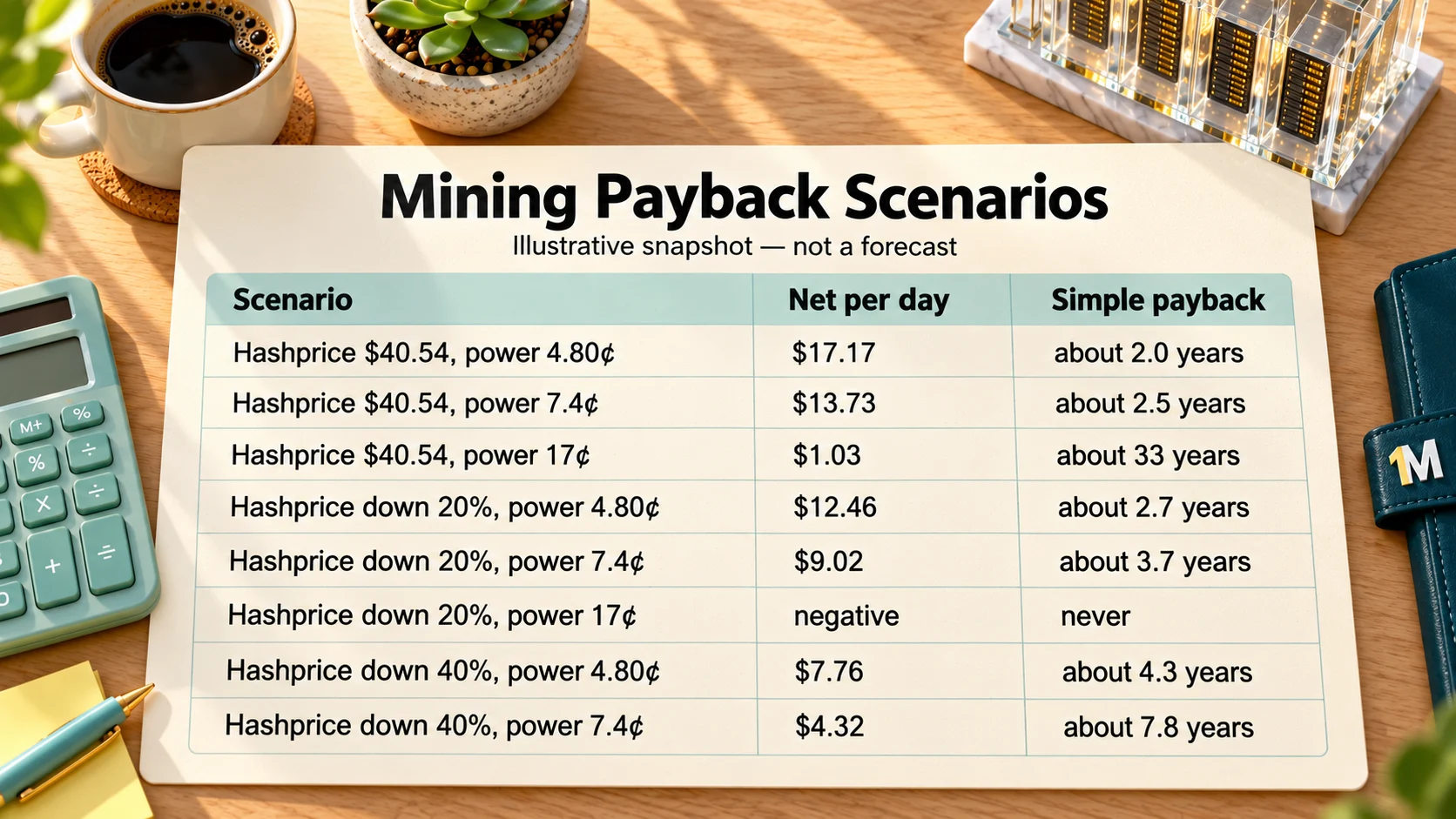
The post’s own figures agree with the first and third rows: about $6.35 a day in power at 4.80 cents versus $22.48 at 17 cents, a gap of roughly $5,889 per unit per year.
What the table is telling you
- Power rate is the biggest swing factor. Moving from 4.8¢ to 7.4¢ extends the simple payback from about two years to roughly two and a half years in this snapshot. At 17¢, the same machine still barely covers electricity at the September hashprice, but the simple hardware payback stretches to roughly 33 years before downtime, repairs, taxes or other costs. In practical terms, that removes most of the investment case even though the electricity-only margin is technically still positive.
- Hashprice risk is real. If hashprice falls 40% from the snapshot, the best case stretches to about 4.3 years.
- Machine lifespan matters. The Simple Mining guide says miners typically last three to five years and that their economic life often ends sooner. A 4-plus-year payback leaves little room.
- It’s a best case. The table ignores difficulty growth, taxes, repair costs after warranty, fees beyond the power rate, downtime, resale value, and any price premium for a machine you ship in yourself (the field guide puts external-miner rates roughly 15 to 17% above the premium rate).
Risks the Company’s Own Post Flags
The OneMiners post correctly emphasizes that mining revenue changes with Bitcoin’s price, network difficulty and transaction fees. It also highlights the 2028 halving, expected around block 1,050,000. The block subsidy will be cut in half at that event. If Bitcoin’s price, difficulty and other conditions were unchanged, hashprice and electricity break-even levels would fall sharply. They would not necessarily fall by exactly 50%, however, because transaction fees are also part of miner revenue and are not cut in half by the halving. Any payback period extending into 2028 should therefore be stress-tested against substantially lower mining revenue rather than assuming today’s hashprice continues unchanged.
It’s also worth reading with the company’s incentives in mind. The post is published by a hosting provider, calls hosting “the clear winner,” and warns against rivals’ practices such as unpublished rates and short contracts. That doesn’t make it wrong. It means the framing favors the seller.
The “#1” Coverage: How Much Weight It Deserves

Search for OneMiners and you’ll find articles ranking it first. Three are worth understanding.
The StreetInsider press release. Best Crypto Mining Hosting Providers in 2026: Top 5 Ranked (OneMiners Takes #1) (September 19, 2026) is labeled “Paid press release content” and was distributed through WorldNewsWire, not written by StreetInsider’s staff. Its criteria are published pricing, contract terms and features. It’s candid in places: it notes that the $0.0364 rate applies only to a seven-year prepaid commitment, that Pay Later means 25% upfront with the balance in three monthly installments, and that OneMiners’ public documents don’t clearly establish a universal three-month minimum or a no-minimum-order policy. It gives no uptime figures.
The New York PR Times “test.” Test of the 10 Best Bitcoin Mining Companies in the World for 2026 and Beyond (March 10, 2026) says ten providers were tested “using identical next-generation ASIC deployments” and “real uptime tracking,” but it names only three, and it doesn’t explain duration, sample size, or who verified results. We found no sponsorship disclosure, though it reads as promotional.
The Medium buyer’s guide. The 2026 Bitcoin Mining Hardware Buyer’s Guide (June 22, 2026) is a sensible primer: ask which miner suits you, put efficiency ahead of raw hashrate, and avoid home mining because of noise, heat and electrical demands. But it has no price, efficiency or break-even figures, and it’s published under a OneMiners.com byline with discount-code links and no explicit affiliate disclosure.
When the claims don’t match
The New York PR Times piece shows why caution is warranted. Several of its OneMiners figures differ from what the company itself publishes:
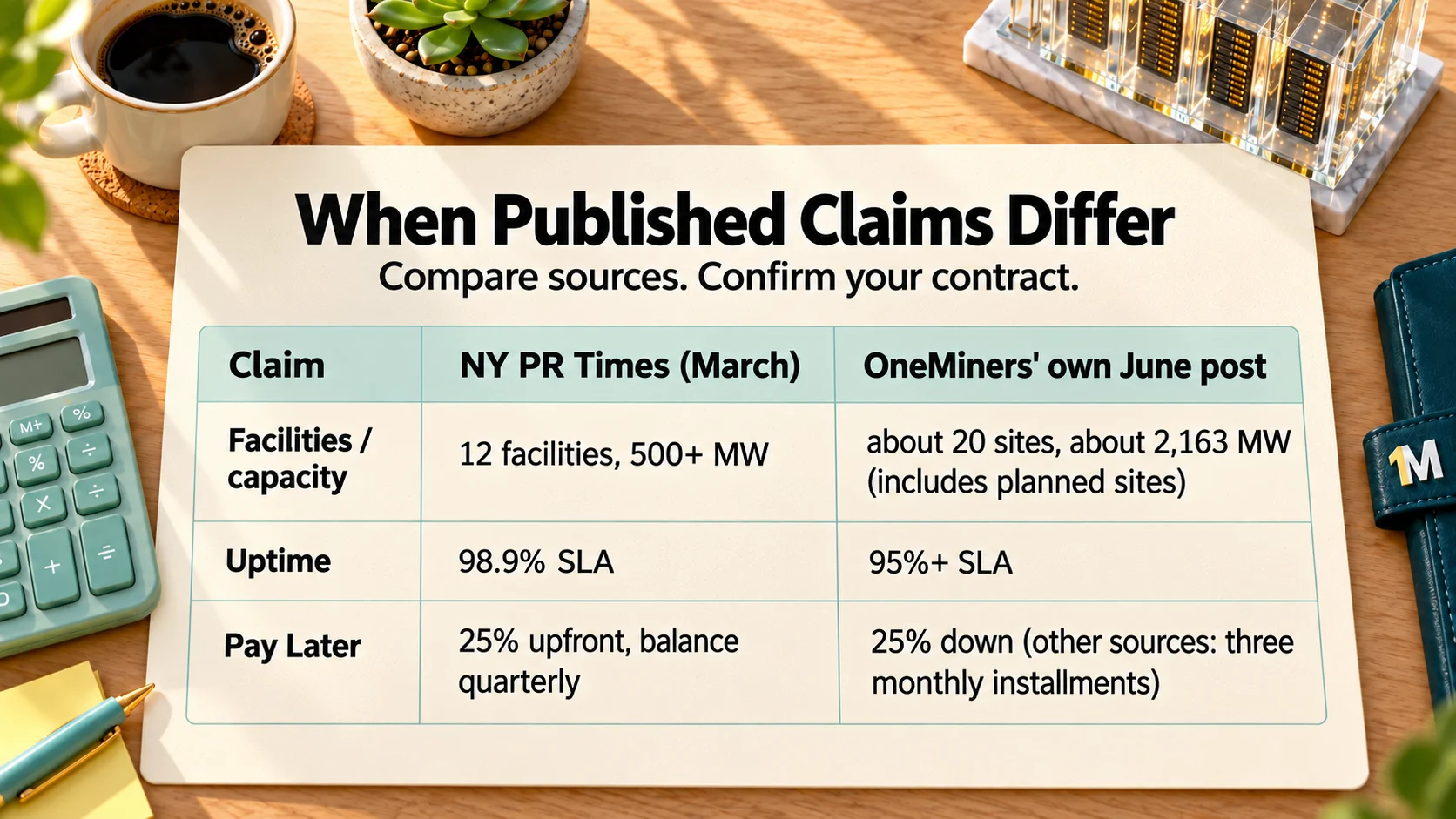
Some of this may reflect growth over time, and uptime figures elsewhere range from 95% to 99.9%. But a “test” whose numbers don’t line up with the company’s own should not be your basis for a buying decision. Get the uptime figure and the compensation in your written agreement.
What Customers Say
Customer reviews provide evidence of reported user experiences, although they are not the same as independently audited operating data. When checked in October 2026, OneMiners’ G2 profile showed a 4.8/5 rating from 38 reviews, up from the 32 reviews shown in an earlier snapshot. G2’s seller page showed roughly 94% five-star and 5% four-star ratings. Many of the visible reviews are labeled Validated Reviewer and Organic, and some are additionally marked Verified Current User. That makes G2 useful as a more structured review source, but the sample is still small enough that it should be read alongside other platforms rather than treated as definitive proof of performance.
What G2 reviewers praise
- Easy setup and onboarding
- A simple dashboard for hashrate, uptime, rewards and payouts
- Not having to handle noise, heat, electricity or maintenance at home
- Responsive support
- Pay Later and promotions making purchases more affordable
What they ask for or complain about
- More frequent updates during order and deployment (the most common complaint)
- Setup and payment confirmations taking days
- A slow dashboard or an awkward mobile layout
- Better reporting and filters
- More beginner tutorials and troubleshooting articles
Other platforms checked in October 2026 show a broadly positive rating profile as well. Trustpilot showed 4.5/5 from 134 reviews, RealReviews showed 4.7/5 from 176 reviews, and ResellerRatings showed a 4.84 headline score from 333 reviews. Their moderation, solicitation and verification systems differ, so the numbers should not be treated as directly equivalent. Across the visible reviews, recurring positive themes include straightforward setup, dashboard usability and helpful support, while recurring complaints include deployment delays, withdrawal or verification friction, and inconsistent communication in some cases.
Terms That Affect Whether It’s “Worth It”
A price that works on paper can stop working if the contractual terms are unfavorable. Several points from OneMiners’ published policy pages deserve clarification before purchase:
- Warranty: the main Warranty Policy describes a 7-year warranty for hosted machines at named facilities and a standard 12-month warranty for directly shipped machines. Other OneMiners legal wording also refers to a 24-month defect warranty in some consumer contexts, so confirm which warranty applies to your specific order, jurisdiction and hosting arrangement.
- Returns: the Returns and Refunds page describes a 14-day return process for most items and requires an RMA, with unwanted returns subject to company acceptance. The Terms contain an “all sales are final” refund clause but also separately describe a 14-day consumer withdrawal right subject to conditions and exceptions. Because the wording does not fully align, get the applicable return rule for your order in writing.
- Hosting and prepaid commitments: hosting orders are described as non-refundable and governed by the hosting agreement. That matters especially if you’re considering a multi-year prepaid electricity plan. Ask what happens to unused prepaid energy if a machine fails permanently, is retired, relocated or replaced.
Who It May Be Worth Considering For
- Buyers who can secure a hosted rate near the low end and will run an efficient, current-generation machine
- People who accept a multi-year payback and can absorb a falling hashprice
- Beginners who want hosting, an app and installment options in one place, and who will start with a single unit
Who Should Think Twice
- Anyone planning to mine at home on typical residential electricity
- Buyers who need a short, flexible commitment, or an unconditional return policy
- Anyone relying on a ranking article as their main evidence
- Anyone who can’t afford to lose the purchase price
Your Pre-Purchase Worksheet
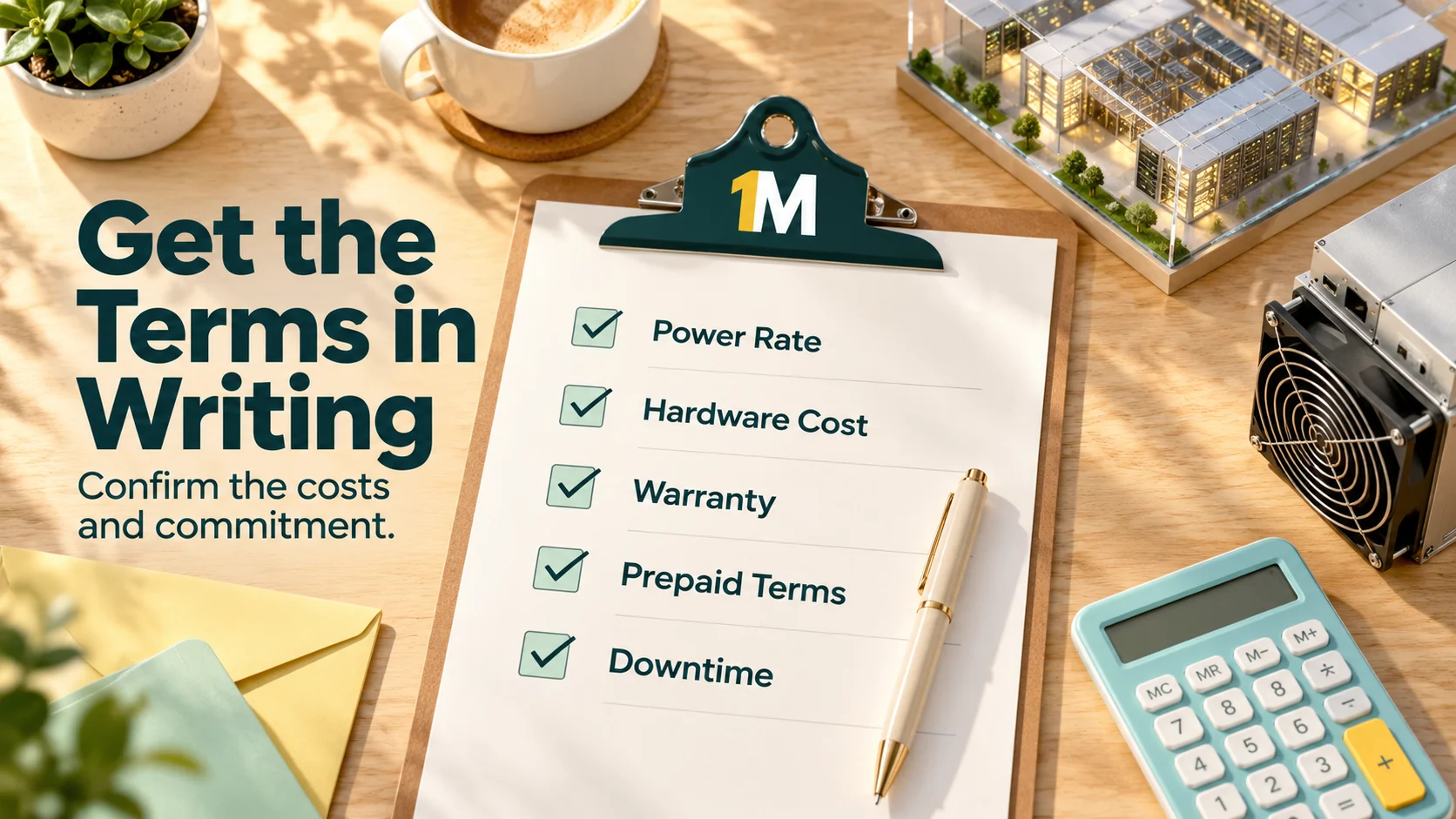
- Get a written quote with the facility, all-in power rate, commitment length and any deposit.
- Pull the machine’s hashrate, power draw and price, and compute its break-even rate.
- Check live hashprice on a tracker or calculator, not last month’s article.
- Run payback at today’s hashprice and at 20% and 40% lower.
- Subtract a realistic allowance for downtime, repairs and taxes.
- Compare the payback with the machine’s likely useful life.
- Confirm warranty, return and prepaid-balance terms in writing.
- Ask support a specific test question and see how clear the reply is.
- Start with one unit, then scale only after you’ve seen the full cycle.
Frequently Asked Questions
Is Bitcoin mining still profitable in 2026? It depends mainly on the machine’s efficiency, current hashprice and your actual electricity rate. In OneMiners’ September snapshot, every machine in its comparison covered electricity at 4.80¢ per kWh. At a 17¢ residential rate, some of the most efficient machines remained slightly above electricity break-even while less efficient models were negative. That does not automatically make home mining attractive, because hardware cost, downtime, cooling, repairs and other expenses still have to be recovered. Always recalculate with current hashprice and your actual all-in power rate.
How long is the payback on a new miner? In our illustration, about two years at the cheapest published hosted rate and flat hashprice, stretching to four years or more if hashprice falls 40%. It is not a forecast.
Are the “OneMiners is #1” articles reliable? Treat them as marketing. One is a labeled paid press release, and another’s “test” is unexplained and conflicts with the company’s own figures.
What do real customers say? G2 shows 4.8 from 32 validated, organic reviews. Praise centers on easy setup, a simple dashboard and responsive support; complaints focus on update frequency and timing.
Does the 2028 halving matter? Yes. The block subsidy is scheduled to fall by 50%, which would significantly reduce mining revenue if Bitcoin’s price, network difficulty and transaction-fee revenue did not compensate. Electricity break-even rates could therefore fall sharply after the halving, but not necessarily by exactly 50% because transaction fees are not halved. This matters especially for a machine whose projected payback extends into 2028.
The Bottom Line
OneMiners can be worth considering in 2026 for a buyer who secures a low electricity rate in writing, chooses an efficient machine, accepts the possibility of a multi-year payback and understands the hosting terms. The September snapshot shows why electricity price matters so much, but it also shows why simple claims such as “home mining never works” or “hosting always wins” need context. At high residential rates, even the most efficient machines may have margins too small to justify their hardware and operating costs, while lower industrial rates provide much more headroom. Do not buy on the strength of a “#1” headline or a single day’s profitability calculation. Run the break-even math with live hashprice, stress-test lower revenue, confirm the warranty and hosting terms, and start with a commitment you can afford to lose.
Sources and Further Reading
- Is Bitcoin Mining Still Worth It in 2026? — OneMiners
- The 2026 Bitcoin Mining Hardware Buyer’s Guide — Medium
- Best Crypto Mining Hosting Providers in 2026: Top 5 Ranked (OneMiners Takes #1) — StreetInsider (paid press release)
- Test of the 10 Best Bitcoin Mining Companies in the World for 2026 and Beyond — New York PR Times
- OneMiners Reviews — G2
- Where Smart Bitcoin Miners Host in America — Medium
- Which ASIC Should I Purchase? — Simple Mining
- Warranty Policy — OneMiners
- Returns and Refunds — OneMiners
- Terms and Conditions — OneMiners
#OneMiners #IsOneMinersWorthIt #BitcoinMining #ASICMining #MiningROI #MiningHosting #CryptoMining #CryptoDueDiligence